
Introduction
Research ethics in the field of health is not merely a formal obligation but constitutes the foundation for protecting the dignity, rights, and well-being of participants. Research ethics refers to an environment in which moral values, integrity, and transparency are more than just norms written in regulatory documents; they are embedded realities of current research practices. To support the production of ethical research and to foster research environments with a high level of integrity, training in the responsible conduct of research is essential [1]. To foster a culture of research integrity and adapt educational programs on the responsible conduct of research, it is essential to understand researchers’ experiences and attitudes toward these issues, particularly among those in the early stages of their careers.
In many countries around the world, studies are conducted to assess the ethical research competencies of early-career researchers. One such example is the study carried out at the Faculty of Medicine of the University of Ljubljana, which evaluated the level of ethical knowledge and attitudes toward research among first-year doctoral students [2]. The findings revealed a very low level of expertise, with an average of only 18.9 correct responses (p < 0.001), compared to the expected score of 31 out of 39 questions. Those with prior research experience obtained higher scores. The authors concluded that, to ensure the responsible development of future researchers, more structured and rigorous educational programs in research ethics are necessary.
Another study conducted within a medical faculty in India aimed to assess the level of knowledge, attitudes, and practices related to research ethics among postgraduate students. The results indicated relatively modest average scores for knowledge, attitude, and practice as well. In conclusion, the authors propose the development of an integrated and comprehensive ethics curriculum, combining problem-focused programs with mentorship [3].
The study conducted by Hofmann et al. (2020) investigated knowledge, attitudes, and practices related to research integrity among doctoral students from medical faculties at three Scandinavian universities, using a questionnaire based on hypothetical scenarios and attitudes toward questionable research practices. The findings highlighted a diversity of perceptions and practices concerning research integrity, with variations across universities and fields of study. Key observations include: a significant number of respondents reported a willingness to fabricate, falsify, or omit contradictory data if they believed the overall conclusions of the study were correct; nearly one-third of respondents indicated that they had unjustly added one or more authors to their publications. The authors conclude that these results suggest that existing educational and research systems are partially failing to promote research integrity [4].
No similar studies have been conducted in the Republic of Moldova. In this context, we decided to develop and validate a questionnaire aimed at supporting the ethical management of research, which would enable the exploration of ethical knowledge regarding the protection of study participants, research integrity, the assessment of attitudes toward the research environment, and the evaluation of perceived ethical competencies. In designing the questionnaire, contextual aspects such as the type of existing training in research ethics, the regulatory framework, and applicable guidelines were taken into consideration.
Materials and methods
The process of developing the questionnaire followed several well-recommended [5, 6] successive stages, namely: 1) questionnaire development; 2) content validity testing; and 3) psychometric analysis, including construct validity testing and internal consistency assessment.
Stage 1. Questionnaire Development. The formulation of the questionnaire items was preceded by the establishment of its conceptual framework and theoretical dimensions. The items were developed based on the international literature on research ethics in the health field, including the World Medical Association Declaration of Helsinki [7] as well as other international guidelines on good research practices and academic integrity, such as the Good Clinical Practice Guideline (ICH GCP E6(R3) [8], and the European Code of Conduct for Research Integrity [9]. The first version of the questionnaire consisted of 79 closed-ended and multiple-choice questions.
Stage 2. Content Validity Testing. Ten experts reviewed the initial version of the questionnaire: four researchers in clinical studies, two researchers in basic science, two researchers in public health, one research manager in the health field, and one ethicist. A qualitative approach was employed, where experts provided a narrative evaluation of each item in terms of clarity, relevance, and domain coverage [10].
Stage 3. Psychometric Evaluation. The questionnaire was sent online (using the Google Forms platform) to doctoral students from the Doctoral School of Medical Sciences at the Nicolae Testemițanu State University of Medicine and Pharmacy in the Republic of Moldova, between March and July 2025. Out of 416 doctoral students, 274 responded to the questionnaire, representing a subject-to-item ratio of approximately 4:1. Although this ratio falls slightly below the commonly recommended 5:1 threshold for exploratory factor analysis [5], Kaiser-Meyer-Olkin (KMO) indicators supported the adequacy of the sample, where a KMO index ≥ 0.60 was considered acceptable, while values above 0.80 indicated excellent suitability of the data for factor analysis [13].
After data collection, the construct validity and internal reliability of the questionnaire were assessed. To identify the latent structure of the questionnaire, exploratory factor analysis (EFA) was applied. This method is recommended for the development and validation of psychometric instruments [11, 12]. The number of latent factors was determined based on the eigenvalue criterion (eigenvalues > 1) and examination of the scree plot [14]. Varimax rotation was applied to obtain a clear factor structure [15].
In the next step, the internal consistency of the questionnaire was assessed using Cronbach’s alpha, along with the alpha-if-item-deleted analysis for each factor identified, in accordance with psychometric instrument development guidelines [16].
Statistical analyses were performed using Microsoft Excel (Microsoft 365) with the Real Statistics add-in, with a significance threshold set at p < 0.05.
Results
Questionnaire Development. A review of the literature in the field contributed to the formulation of 79 items, designed to cover four dimensions: (1) knowledge of ethical standards in research involving human subjects (14 items); (2) attitudes regarding research resources (importance versus accessibility) (21 items); (3) attitudes toward institutional measures aimed at ensuring research integrity (20 items); and (4) participants’ self-assessed ethical competencies (14 items). The items were formulated as statements with responses on a 5-point Likert scale, except for questions intended to collect sociodemographic data from participants (10 items).
Content Validity Testing. The initial version of the questionnaire was sent to 10 experts who evaluated its content and provided recommendations and suggestions regarding clarity, relevance, and domain coverage. Based on the experts’ feedback, 20 questions were reformulated, and additional items were included in the questionnaire: one question for the sociodemographic section, one open-ended question for each of dimensions 1–3, and two open-ended questions for dimension 4. This resulted in a revised version of the questionnaire consisting of 85 items.
Characteristics of the study participants. Analysis of the respondents’ sociodemographic characteristics revealed a predominantly female profile (72.6% [95% CI: 67.1%–77.6%]), with a median age of 35 years and IQR = 32–39 (skewness > 1). Most participants were at an early stage of their research careers, with 0–5 years of research experience (73.4% [95% CI: 67.8%–78.5%]), and the majority had received prior training in research ethics (72.6% [95% CI: 67.1%–77.6%]), primarily through formal instruction sessions. This profile indicates that the sample represents early-career researchers with foundational exposure to ethical training, providing a relevant context for evaluating both the clarity and applicability of the questionnaire items.
Psychometric Analysis. The psychometric analysis was conducted on 70 items; open-ended questions and those aimed at collecting sociodemographic data were excluded from the evaluation. To identify the latent structure of the questionnaire, an exploratory factor analysis (EFA) was performed using the principal component analysis (PCA) extraction method. To assess whether the set of variables (questionnaire items) was suitable for identifying latent factors, the Kaiser-Meyer-Olkin (KMO) measure of sampling adequacy was evaluated. The KMO values for individual items ranged from 0.60 to 0.95, except item 2 (which had a value of 0.33), indicating that, overall, the data were adequate for factor analysis.
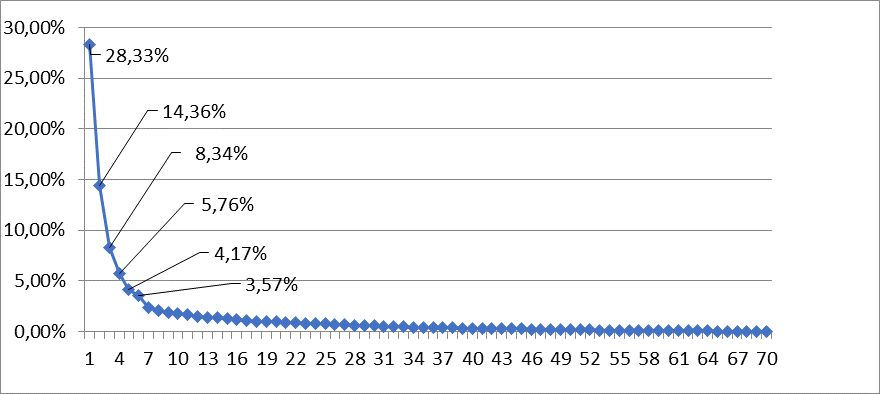
According to the Kaiser criterion, 11 factors with eigenvalues values > 1were initially identified. However, to ensure a stable structure, only factors with eigenvalues > 2 were retained, resulting in six factors. The first factor explained 28.33% of the total variance, the second 14.36%, and the third 8.34%. Subsequent factors contributed smaller proportions (5.76%, 4.17%, and 3.57%, respectively). Together, these six factors accounted for approximately 64.5% of the total variance, indicating a strong capacity of the questionnaire to capture the latent dimensions of the construct under investigation. The Scree Plot [14] confirmed this factor solution by highlighting an “elbow” after the sixth factor, where the slope of the curve levels off. Figure 1 presents the variance of the identified factors.
|
Fig. 1 Variance of the identified factors (Scree Plot). Note: The figure shows the eigenvalues for each extracted factor. The “elbow” after the sixth factor, where the curve levels off, supports the retention of a six-factor solution. |
The factor loading matrix was carefully examined to identify the items most strongly associated with each factor. To enhance the interpretability of the loadings for each item (Full Load Matrix), an orthogonal Varimax rotation was applied. Loadings greater than 0.40 were considered significant for inclusion in the factor structure [17, p.151]. Among the 70 items analyzed, 61 items met this threshold, while 2 items had slightly lower loadings of 0.35 and 0.37, respectively. Seven items exhibited loadings below 0.35 and were consequently excluded from further analysis. Overall, 63 items were retained for subsequent psychometric evaluation, ensuring a robust and reliable factor structure for the questionnaire.
For each identified factor, internal consistency was assessed using Cronbach’s alpha, with a threshold of ≥ 0.70 considered indicative of satisfactory internal reliability [18]. Additionally, to evaluate the contribution of individual items to the overall coherence of each scale, the alpha-if-item-deleted analysis was conducted.
Analysis of Factor Loadings and Cronbach’s Alpha by Factor.
Factor I – Important Research Resources. This factor encompasses items designed to assess participants’ perceptions of the importance of various resources essential for conducting good health research. These include adequate funding, research infrastructure, qualified personnel, access to data and databases, clear institutional regulations, interdisciplinary collaborations, administrative and logistical support, sufficient time for research, research and ethics training programs, and mechanisms for study oversight. The items are presented in Table 1.
Table 1. Factor I: Important Research Resources | |||||
Item | 1 | 2 | 3 | 4 | 5 |
|
|
|
|
|
|
|
|
|
|
|
|
|
|
|
|
|
|
|
|
|
|
|
|
|
|
|
|
|
|
|
|
|
|
|
|
|
|
|
|
|
|
|
|
|
|
|
|
|
|
|
|
|
|
|
|
|
|
|
|
Note: The subjects were asked to indicate the extent to which they agree with the following statements regarding important research resources, using the scale: 1 = not important, 2 = slightly important, 3 = moderately important, 4 = important, 5 = essential. | |||||
All items within this factor demonstrated very high factor loadings (ranging from -0.877 to -0.934), indicating a strong coherence and conceptual integrity of the construct. Internal consistency analysis confirmed excellent reliability, with a Cronbach’s alpha of 0.989. Furthermore, the alpha-if-item-deleted analysis revealed values ranging from 0.987 to 0.990, with no significant fluctuations, thereby confirming that each item contributes positively to the overall consistency of the scale. These findings are summarized in Table 2.
Table 2. Statistical analysis of Factor I, including factor loadings and Cronbach’s alpha values. | |||
| Items | Loadings | Cronbach’s alpha-if-item-deleted |
Factor I | Item 1 | -0,877 | 0,990 |
Item 2 | -0,928 | 0,987 | |
Item 3 | -0,924 | 0,987 | |
Item 4 | -0,932 | 0,987 | |
Item 5 | -0,934 | 0,987 | |
Item 6 | -0,907 | 0,988 | |
Item 7 | -0,920 | 0,987 | |
Item 8 | -0,929 | 0,987 | |
Item 9 | -0,910 | 0,988 | |
Item 10 | -0,906 | 0,988 | |
Note: Factor loadings represent the correlation between each item and Factor I, extracted through exploratory factor analysis using principal component extraction with varimax rotation. Cronbach’s alpha-if-item-deleted indicates the internal consistency of the factor when the respective item is removed. All items were assessed on a Likert-type scale (1-5) | |||
Factor II – Perceived Ethical Competencies in Research
This factor encompasses items designed to evaluate researchers’ self-perceived proficiency in research ethics and scientific integrity. It addresses competencies such as the application of international and national ethical regulations, protection of study participants, obtaining informed consent, maintaining data confidentiality, responsible data management, and other related ethical practices. All items of the factor are presented in Table 3.
Table 3. Factor II: Perceived Ethical Competencies in Research | |||||
Item | 1 | 2 | 3 | 4 | 5 |
|
|
|
|
|
|
|
|
|
|
|
|
|
|
|
|
|
|
|
|
|
|
|
|
|
|
|
|
|
|
|
|
|
|
|
|
|
|
|
|
|
|
|
|
|
|
|
|
|
|
|
|
|
|
|
|
|
|
|
|
|
|
|
|
|
|
|
|
|
|
|
|
|
|
|
|
|
|
|
|
|
|
|
|
|
|
|
|
|
|
Note: The subjects are asked to evaluate their level of preparedness in the following areas/aspects of research, using the following scale: 1 = not at all prepared, 2 = slightly prepared, 3 = moderately prepared, 4 = prepared, 5 = very prepared. | |||||
The factor loadings ranged from 0.614 to 0.857, reflecting a strong and consistent association between the items and the underlying construct. Internal consistency analysis confirmed a high level of reliability, with a Cronbach’s alpha of 0.961. Additionally, the “Cronbach’s alpha if item deleted” values varied between 0.956 and 0.960, indicating that each item contributes substantially to the overall scale and that none of the items compromises the coherence of the construct. This demonstrates that Factor II provides a robust measure of researchers’ perceived ethical competencies in the context of scientific practice. These findings are summarized in Table 4.
Table 4. Statistical analysis of Factor II, including factor loadings and Cronbach’s alpha values. | |||
| Items | Loadings | Cronbach’s alpha-if-item-deleted |
Factor II | Item 1 | -0,614 | 0,960 |
Item 2 | -0,682 | 0,959 | |
Item 3 | -0,682 | 0,959 | |
Item 4 | -0,783 | 0,957 | |
Item 5 | -0,831 | 0,957 | |
Item 6 | -0,841 | 0,957 | |
Item 7 | -0,820 | 0,957 | |
Item 8 | -0,751 | 0,959 | |
Item 9 | -0,761 | 0,958 | |
Item 10 | -0,804 | 0,958 | |
Item 11 | -0,808 | 0,958 | |
Item 12 | -0,850 | 0,957 | |
Item 13 | -0,857 | 0,956 | |
Item 14 | -0,833 | 0,957 | |
Item 15 | -0,790 | 0,958 | |
Note: Factor loadings represent the correlation between each item and Factor II, extracted through exploratory factor analysis using principal component extraction with varimax rotation. Cronbach’s alpha-if-item-deleted indicates the internal consistency of the factor when the respective item is removed. All items were assessed on a Likert-type scale (1-5) | |||
Factor III – Measures Implemented to Ensure a Research Integrity Climate
This factor comprises items assessing researchers’ attitudes toward the implementation of institutional measures aimed at ensuring research integrity. These include clear policies on integrity, periodic audits and sanctions, promotion of ethical behavior by leadership, management of conflicts of interest, prevention of favoritism and undue influence, plagiarism prevention, and related practices. The questions of Factor III are presented in Table 5.
Table 5. Factor III: Measures Implemented to Ensure a Research Integrity Climate | |||||
Item | 1 | 2 | 3 | 4 | 5 |
|
|
|
|
|
|
|
|
|
|
|
|
|
|
|
|
|
|
|
|
|
|
|
|
|
|
|
|
|
|
|
|
|
|
|
|
|
|
|
|
|
|
|
|
|
|
|
|
|
|
|
|
|
|
Note: The subjects were asked to indicate the extent to which the listed measures, aimed at ensuring the quality and integrity of research data, are implemented in their institution, using the scale: 1 = not implemented, 2 = limited implemented, 3 = moderately implemented, 4 = well implemented, 5 = fully implemented. | |||||
Factor loadings ranged from 0.777 to 0.881, indicating that all items contribute significantly and coherently to defining the construct. The overall internal consistency for this factor was very high (Cronbach’s alpha = 0.989), and the “Cronbach’s alpha if item deleted” values ranged between 0.987 and 0.990, confirming that the removal of any single item would not substantially improve the reliability of the scale. These results demonstrate that Factor III provides a robust measure of researchers’ perceptions of the implementation of institutional integrity measures. These findings are summarized in Table 6.
Table 6. Statistical analysis of Factor III, including factor loadings and Cronbach’s alpha values. | |||
| Items | Loadings | Cronbach’s alpha-if-item-deleted |
Factor III | Item 1 | 0,841 | 0,990 |
Item 2 | 0,848 | 0,988 | |
Item 3 | 0,839 | 0,987 | |
Item 4 | 0,848 | 0,989 | |
Item 5 | 0,858 | 0,987 | |
Item 6 | 0,870 | 0,987 | |
Item 7 | 0,881 | 0,987 | |
Item 8 | 0,777 | 0,987 | |
Item 9 | 0,866 | 0,987 | |
Note: Factor loadings represent the correlation between each item and Factor III, extracted through exploratory factor analysis using principal component extraction with varimax rotation. Cronbach’s alpha-if-item-deleted indicates the internal consistency of the factor when the respective item is removed. All items were assessed on a Likert-type scale (1-5) | |||
Factor IV – Ethical Principles and Moral Responsibilities in Research
This factor includes items assessing knowledge of ethical standards in research, such as the rights, safety, and well-being of participants, research integrity, and moral responsibility in human subjects’ research. These items are presented in Table 7.
Table 7. Factor IV: Ethical Principles and Moral Responsibilities in Research | |||||
Item | 1 | 2 | 3 | 4 | 5 |
|
|
|
|
|
|
|
|
|
|
|
|
|
|
|
|
|
|
|
|
|
|
|
|
|
|
|
|
|
|
|
|
|
|
|
|
|
|
|
|
|
|
|
|
|
|
|
|
|
|
|
|
|
|
|
|
|
|
|
|
Note: The subject is asked to indicate the extent to which they agree with the listed statements, using the scale: 1 = strongly disagree, 2 = partially disagree, 3 = neither agree nor disagree, 4 = partially agree, 5 = strongly agree. | |||||
Factor loadings ranged from -0.353 to -0.692. Items 1 and 10 displayed relatively low loadings, indicating a weaker association with the latent construct; however, they were retained in the analysis due to their theoretical importance, as they address specific dimensions of ethical responsibilities. Overall internal consistency for this scale was satisfactory, with a Cronbach’s alpha of 0.738. The “Cronbach’s alpha if item deleted” values ranged from 0.697 to 0.733, which is acceptable, although some items had a lower impact on the overall homogeneity of the scale. These results suggest that Factor IV captures key aspects of ethical principles and moral responsibilities, even if certain items contribute less strongly to the latent construct. These findings are summarized in Table 8.
Table 8. Statistical analysis of Factor IV, including factor loadings and Cronbach’s alpha values. | |||
| Items | Loadings | Cronbach’s alpha-if-item-deleted |
Factor IV | Item 1 | -0,374 | 0,725 |
Item 2 | 0,572 | 0,715 | |
Item 3 | -0,535 | 0,721 | |
Item 4 | 0,692 | 0,697 | |
Item 5 | -0,452 | 0,733 | |
Item 6 | 0,673 | 0,698 | |
Item 7 | 0,639 | 0,701 | |
Item 8 | -0,430 | 0,723 | |
Item 9 | -0,436 | 0,722 | |
Item 10 | -0,353 | 0,728 | |
Note: Factor loadings represent the correlation between each item and Factor IV, extracted through exploratory factor analysis using principal component extraction with varimax rotation. Cronbach’s alpha-if-item-deleted indicates the internal consistency of the factor when the respective item is removed. All items were assessed on a Likert-type scale (1-5) | |||
Within the factor, some loadings are positive while others are negative, which can be explained by the existence of an inverse relationship between those items and the latent factor. In factor analysis, the sign of a loading is relative; what matters is the absolute magnitude of the loading, which indicates the strength of the relationship between the item and the factor.
Factor V – Accessible Research Resources
This factor comprises items assessing researchers’ perceptions of the accessibility of resources necessary for conducting research. The factor items are presented in Table 9.
Table 9. Factor V: Accessible Research Resources | |||||
Item | 1 | 2 | 3 | 4 | 5 |
|
|
|
|
|
|
|
|
|
|
|
|
|
|
|
|
|
|
|
|
|
|
|
|
|
|
|
|
|
|
|
|
|
|
|
|
|
|
|
|
|
|
|
|
|
|
|
|
|
|
|
|
|
|
|
|
|
|
|
|
Note: Participants were asked to indicate the extent to which the listed research resources are accessible to them, using the scale: 1 = not accessible, 2 = limited access, 3 = moderate access, 4 = good access, 5 = full access. | |||||
Factor loadings ranged from 0.586 to 0.739, indicating that all items contribute significantly to defining this construct. In comparison, Factor I, which evaluates the perceived importance of the same resources, exhibited substantially higher loadings. This discrepancy may be explained by the fact that researchers generally recognize the intrinsic value of essential research resources. In contrast, their perception of accessibility depends on individual experience and the institutional context in which they operate. Internal consistency for this factor was excellent, with a Cronbach’s alpha of 0.912. The “alpha if item deleted” values ranged from 0.898 to 0.912, confirming that each item contributes meaningfully to the overall reliability of the scale. These findings are summarized in Table 10.
Table 10. Statistical analysis of Factor V, including factor loadings and Cronbach’s alpha values. | |||
| Items | Loadings | Cronbach’s alpha-if-item-deleted |
Factor V | Item 1 | 0,626 | 0,911 |
Item 2 | 0,655 | 0,906 | |
Item 3 | 0,675 | 0,901 | |
Item 4 | 0,684 | 0,902 | |
Item 5 | 0,613 | 0,900 | |
Item 6 | 0,693 | 0,899 | |
Item 7 | 0,693 | 0,899 | |
Item 8 | 0,586 | 0,912 | |
Item 9 | 0,739 | 0,898 | |
Item 10 | 0,711 | 0,898 | |
Note: Factor loadings represent the correlation between each item and Factor V, extracted through exploratory factor analysis using principal component extraction with varimax rotation. Cronbach’s alpha-if-item-deleted indicates the internal consistency of the factor when the respective item is removed. All items were assessed on a Likert-type scale (1-5) | |||
Factor VI – Important Measures to Ensure a Research Integrity Climate
This factor comprises items assessing the perceived importance of implementing institutional and organizational measures to ensure quality and integrity in research. The factor items are included in Table 11.
Table 11. Factor VI: Important Measures to Ensure a Research Integrity Climate | |||||
Item | 1 | 2 | 3 | 4 | 5 |
|
|
|
|
|
|
|
|
|
|
|
|
|
|
|
|
|
|
|
|
|
|
|
|
|
|
|
|
|
|
|
|
|
|
|
|
|
|
|
|
|
|
|
|
|
|
|
|
|
|
|
|
|
|
Note: Participants were asked to indicate which of the listed measures can be considered important for ensuring the quality and integrity of research data, using the scale: 1 = not important, 2 = slightly important, 3 = moderately important, 4 = important, 5 = essential. | |||||
Factor loadings were strong, ranging from 0.812 to 0.868, indicating a robust association between each item and the underlying construct. Internal consistency for this factor was very high, with a Cronbach’s alpha of 0.974. The “alpha if item deleted” values ranged from 0.969 to 0.973, demonstrating that the removal of any single item would not significantly improve the reliability of the scale. These findings are summarized in Table 12.
Table 12. Statistical analysis of Factor VI, including factor loadings and Cronbach’s alpha values. | |||
| Items | Loadings | Cronbach’s alpha-if-item-deleted |
Factor VI | Item 1 | 0,812 | 0,971 |
Item 2 | 0,823 | 0,970 | |
Item 3 | 0,840 | 0,970 | |
Item 4 | 0,842 | 0,970 | |
Item 5 | 0,859 | 0,970 | |
Item 6 | 0,856 | 0,971 | |
Item 7 | 0,862 | 0,969 | |
Item 8 | 0,868 | 0,973 | |
Item 9 | 0,861 | 0,970 | |
Note: Factor loadings represent the correlation between each item and Factor VI, extracted through exploratory factor analysis using principal component extraction with varimax rotation. Cronbach’s alpha-if-item-deleted indicates the internal consistency of the factor when the respective item is removed. All items were assessed on a Likert-type scale (1-5) | |||
Overall, these results indicate that the questionnaire demonstrates robust psychometric properties, with high factor loadings and internal consistency across most factors, supporting its validity for assessing ethical knowledge, attitudes, and perceptions among early-career researchers.
Discussion
The exploratory factor analysis of the questionnaire revealed a multidimensional structure comprising six primary factors, collectively explaining approximately 64.5% of the total variance. Factor loadings were generally high, indicating strong associations between items and their respective constructs. Internal consistency across factors ranged from good to excellent, with Cronbach’s alpha values between 0.738 and 0.989.
However, the literature notes that alpha values exceeding 0.95 may indicate potential item redundancy, suggesting that respondents might perceive certain items as overly similar [19]. For instance, within Factor I (Cronbach’s alpha = 0.989), items such as adequate funding and administrative support could be interpreted by participants as closely related, reflecting overlapping aspects of the same construct. To minimize potential interpretation ambiguities, each item within the factor was accompanied by a clarifying description. For example, “Adequate funding” referred specifically to resources for equipment, materials, and researcher salaries, whereas “Administrative and logistical support” addressed management of documentation, procurement, and team coordination. While reducing the number of items could potentially decrease redundancy, maintaining a broad range of items ensures that multiple dimensions of the construct are captured. This approach aligns with the exploratory objective of the questionnaire, allowing for a comprehensive assessment of researchers’ perceptions and experiences.
Several questionnaires have been developed to assess research ethics and integrity [20]. For example, Thrush et al. (2007) created a questionnaire to evaluate organizational culture in terms of research integrity, which demonstrated strong content validity (CVI = 0.90) after the removal of problematic items [21].
The SORC questionnaire is considered the first standardized instrument developed to assess organizational climate regarding research integrity [22]. Initially applied among academic researchers in the United States, it has subsequently been adapted and implemented in other cultural contexts [23, 24]. The instrument demonstrated strong reliability, with internal consistency coefficients (Cronbach’s alpha) ranging from 0.80 to 0.87.
The questionnaire developed by Mavrinac et al. (2010) is an instrument designed to measure students’ attitudes toward plagiarism across three factors: positive attitudes (e.g., perceived acceptability of plagiarism), negative attitudes (e.g., moral disapproval of plagiarism), and subjective norms (e.g., perceived social expectations). Internal consistency coefficients demonstrated good reliability for all three factors (0.83, 0.79, and 0.85), as confirmed through confirmatory factor analysis [25].
The Research Conduct Attitudes Scale is a two-factor instrument assessing (a) the perceived acceptability of ethically questionable research practices and (b) general attitudes toward unethical research behavior [26]. Both factors demonstrated good internal consistency, with Cronbach’s alpha values exceeding 0.75.
A valid instrument for assessing researchers’ knowledge and attitudes regarding participant rights in studies and research ethics education was developed in Saudi Arabia by Al-Madaney and Fässler [27]. The questionnaire's overall content validity indices exceeded 0.78 for all sections of the questionnaire; the split-half reliability coefficient was 0.755 for knowledge items, and Cronbach’s alpha for the attitude scale was 0.77.
All of the studies mentioned share a common objective of operationalizing complex ethical constructs, such as knowledge and attitudes toward plagiarism, organizational climate, responsible conduct of research (RCR), and respect for human subjects’ rights. At the same time, these instruments differ in their focus: some target specific domains (e.g., plagiarism), whereas others address broader constructs, such as organizational climate or research integrity culture.
Our study complements existing instruments and contributes to the field through its exploratory nature, targeting multidimensional aspects of research ethics, including the assessment of researchers’ knowledge of ethical standards, their perceptions and attitudes toward the research environment, and their confidence in their own moral competencies. The internal consistency of the present questionnaire was very high for the majority of factors, which is comparable to previously published instruments. This questionnaire aligns with national trends in the development of validated instruments in the field of health sciences that are contextually relevant [28].
Even if the study presents a robust, multidimensional instrument for assessing researchers’ knowledge and perceptions of ethics and integrity, its generalizability may be limited by the sample characteristics. Future research is recommended to validate the instrument in larger and more diverse populations and to conduct confirmatory factor analysis (CFA) to assess the factor structure of the scale. The questionnaire does not directly assess current ethical practices, highlighting the potential need for more specific instruments to assess distinct ethical behaviors in future studies.
Conclusions
The study demonstrated that the tested questionnaire is a robust and valid instrument for assessing knowledge and attitudes regarding research ethics and integrity in the health sciences. It can serve as an internal audit tool to evaluate the research integrity climate, researchers’ satisfaction with available resources, and the implementation of institutional policies. Additionally, the instrument can inform the planning of targeted training programs and professional development initiatives, identifying areas where researchers exhibit insufficient knowledge or understanding of research ethics.
Competing interests
None declared.
Authors’ contributions
All the authors participated in the study design, critically reviewed the work, and approved the final version of the manuscript.
Acknowledgment and funding
We express our sincere gratitude to the experts who contributed to the assessment of the questionnaire’s content validity, to the Doctoral School office for their support, and to all researchers who dedicated their time to completing the questionnaire. The study was conducted within the framework of the postdoctoral project “Ethical Management of Health Research”.
Ethics approval and participant consent
The study was approved by the Research Ethics Committee of Nicolae Testemițanu State University of Medicine and Pharmacy in the Republic of Moldova, Minutes No.70, dated August 08, 2024. Implicit consent was obtained.
Provenance and peer review
Not commissioned; externally peer-reviewed.
Use of AI in manuscript preparation.
AI (GPT-4) was used solely to assist in drafting and refining the text; the authors conducted all analyses, interpretations, and conclusions.
Authors’ ORCID IDs:
Adriana Paladi – https://orcid.org/0000-0002-3655-0640
Valentin Mîța – https://orcid.org/0000-0002-5669-7455
Lilian Șaptefrați – https://orcid.org/0000-0003-2779-718X
References
Kretser A, Murphy D, Bertuzzi S, Abraham T, Allison DB, Boor KJ, et al. Scientific integrity principles and best practices: recommendations from a Scientific Integrity Consortium. Sci Eng Ethics. 2019;25(2):327-55. doi: 10.1007/s11948-019-00094-3.
Grosek S, Pleterski Rigler D, Podbregar M, Erčulj V. Knowledge of and attitudes towards medical research ethics among first-year doctoral students in Slovenia at the Faculty of Medicine, University of Ljubljana. BMC Med Educ. 2023;23(1):828. doi: 10.1186/s12909-023-04809-w.
Channashetti DRD, Sonoli DSS. Human research ethics among postgraduate medical students in a medical college of South India. South East Eur J Public Health. 2025;26:801-9. https://doi.org/10.70135/seejph.vi.3763.
Hofmann B, Bredahl Jensen L, Eriksen MB, Helgesson G, Juth N, Holm S. Research integrity among PhD students at the Faculty of Medicine: a comparison of three Scandinavian Universities. J Empir Res Hum Res Ethics. 2020;15(4):320-9. doi: 10.1177/1556264620929230.
Yusoff MSB, Arifin WN, Hadie SNH. ABC of questionnaire development and validation for survey research. Educ Med J. 2021;13(1):97-108. https://doi.org/10.21315/eimj2021.13.1.10.
Boateng GO, Neilands TB, Frongillo EA, Melgar-Quiñonez HR, Young SL. Best practices for developing and validating scales for health, social, and behavioral research: a primer. Front Public Health. 2018;6:149. doi: 10.3389/fpubh.2018.00149.
World Medical Association. WMA Declaration of Helsinki: ethical principles for medical research involving human participants [Internet]. Ferney-Voltaire (France): WMA; 2025 [cited 2025 Aug 26]. Available from: https://www.wma.net/policies-post/wma-declaration-of-helsinki-ethical-p…
International Council for Harmonization of Technical Requirements for Pharmaceuticals for Human Use (ICH). ICH Guideline for good clinical practice E6(R3). Geneva: ICH; 2025 [cited 2025 Aug 26]. Available from: https://database.ich.org/sites/default/files/ICH_E6%28R3%29_Step4_Final…
All European Academies (ALLEA). The European code of conduct for research integrity. Revised ed. Berlin: ALLEA; 2023. 40 p.
Haynes SN, Richard DCS, Kubany ES. Content validity in psychological assessment: a functional approach to concepts and methods. Psychol Assess. 1995;7(3):238-47. doi: 10.1037/1040-3590.7.3.238.
Fabrigar LR, Wegener DT, MacCallum RC, Strahan EJ. Evaluating the use of exploratory factor analysis in psychological research. Psychol Methods. 1999;4(3):272-99. doi: 10.1037/1082-989X.4.3.272.
Costello AB, Osborne J. Best practices in exploratory factor analysis: four recommendations for getting the most from your analysis. Pract Assess Res Eval. 2005;10(1):7. doi: https://doi.org/10.7275/jyj1-4868.
Kaiser HF. An index of factorial simplicity. Psychometrika. 1974;39(1):31-6. doi: 10.1007/BF02291575.
Cattell RB. The Scree test for the number of factors. Multivariate Behav Res. 1966;1(2):245-76. doi: 10.1207/s15327906mbr0102_10.
Kaiser HF. The varimax criterion for analytic rotation in factor analysis. Psychometrika. 1958;23(3):187-200. doi: 10.1007/BF02289233.
DeVellis RF, Thorpe CT. Scale development: theory and applications. 5th ed. Los Angeles: SAGE; 2022. 344 p.
Hair JF, editor. Multivariate data analysis: a global perspective. 7th ed. Upper Saddle River (NJ): Pearson; 2010. 800 p.
Ahmad MAN, Roni SM. PLS analysis – guidelines to evaluate measures. ResearchGate. 2014. doi: 10.13140/2.1.2368.2240.
Taber KS. The Use of Cronbach’s Alpha when developing and reporting research instruments in science education. Res Sci Educ. 2018;48(6):1273-96. doi: 10.1007/s11165-016-9602-2.
Redman BK. Review of measurement instruments in research ethics in the biomedical sciences, 2008-2012. Res Ethics. 2014;10(3):141-50. doi: 10.1177/1747016114538963.
Thrush CR, Putten JV, Rapp CG, Pearson LC, Berry KS, O’Sullivan PS. Content validation of the organizational climate for research integrity (OCRI) survey. J Empir Res Hum Res Ethics. 2007;2(4):35-52. doi: 10.1525/jer.2007.2.4.35.
Martinson BC, Thrush CR, Crain AL. Development and validation of the survey of organizational research climate (SORC). Sci Eng Ethics. 2013;19(3):813-34. doi: 10.1007/s11948-012-9410-7.
Armond ACV, Kakuk P. Perceptions of research integrity climate in Hungarian universities: results from a survey among academic researchers. Sci Eng Ethics. 2022;28(4):30. doi: 10.1007/s11948-022-00382-5.
Haven TL, Tijdink JK, Martinson BC, Bouter LM. Perceptions of research integrity climate differ between academic ranks and disciplinary fields: results from a survey among academic researchers in Amsterdam. PLoS One. 2019;14(1):e0210599. doi: 10.1371/journal.pone.0210599.
Mavrinac M, Brumini G, Bilić-Zulle L, Petrovečki M. Construction and validation of attitudes toward plagiarism questionnaire. Croat Med J. 2010;51(3):195-201. doi: 10.3325/cmj.2010.51.195.
Abd ElHafeez S, Salem M, Silverman HJ. Reliability and validation of an attitude scale regarding responsible conduct in research. PLoS One. 2022;17(3):e0265392. doi: 10.1371/journal.pone.0265392.
Al-Madaney MM, Fässler M. Development and validation of a tool to assess researchers’ knowledge of human subjects’ rights and their attitudes toward research ethics education in Saudi Arabia. BMC Med Ethics. 2023;24(1):94. doi: 10.1186/s12910-023-00968-z.
Bologan V, Mazur-Nicorici L, Spinei L, Cebanu S, Visnevschi A, Ciobanu E. Development and validation of a questionnaire for hygienic estimation of the impact of risk factors on morbidity due to osteoporosis. Mold J Health Sci. 2024;4(11):15–21. doi: 10.52645/MJHS.2024.4.03.