Table of contents
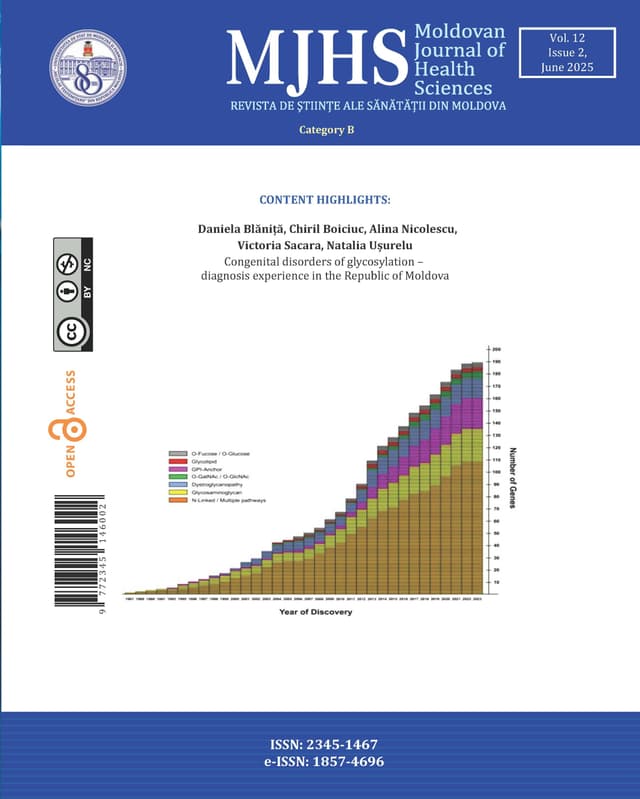
12 papers · pp. 3–74Congenital disorders of glycosylation - diagnosis experience in the Republic of Moldova
Abstract
Introduction
Congenital disorders of glycosylation (CDG) represent a group of rare diseases with multisystem involvement and exponential expansion, characterized by defects in the glycosylation process, which is essential for the proper functioning of proteins and lipids. These often manifest under the guise of other pathologies. The objective of the study was to diagnose CDG using Isoelectric Focusing of Transferrin (IEFT) in the Republic of Moldova and to identify diseases that mimic CDG.
Material and methods
Following medical-genetic consultations at the Institute of Mother and Child, 320 patients suspected for CDG were selected. History, clinical and paraclinical data were collected, and the proposed research questionnaire was completed. After signing the informed consent, the biological samples (serum, plasma, urine, DNA, DBS) were collected from all patients. Screening serum using the IEFT method was performed for 150 patients due to limited availability of reagents. For cases with negative CDG results, selective molecular-genetic tests such as MLPA, CGH-array, WES/WGS were performed.
Results
Clinical and paraclinical examination of patients suspected CDG revealed multisystem involvement in 99.1% of cases, predominantly affecting the central nervous system in 92.2%. System and organ evaluation showed that, in addition to neurological damage there were skeletal (22.5%), renal (10.9%), ophthalmological (38.8%), muscular (22.5%), hepatic (20.9%), cardiac (40.6%), auditory (5.9%), pulmonary (3.8%), and gastrointestinal (29.4%) involvement. Analysis of 150 serum samples by IEFT method identified 3 positive cases for CDG. Molecular genetic testing revealed additional two CDG cases with negative IEFT and over 50 rare pathologies that manifest under the guise of CDG.
Conclusions
Clinical heterogeneity and disruptions in various biological pathways contribute to the complexity of CDG diagnosis. The clinical overlap of genetic diseases represents a considerable challenge for clinicians, as similar symptoms between different genetic conditions can lead to confusion and delay in identifying the disease.
Thrombosis and hemostatic abnormalities in non-Hodgkin lymphoma
Abstract
Introduction
Non-Hodgkin lymphoma is a heterogeneous group of malignant lymphoid tumors. Hemostasis disorders in non-Hodgkin lymphoma are often asymptomatic but can develop into severe complications. The risk of venous thromboembolism increases according to the totality of risk factors assessed directly in each individual patient, based on age, gender, comorbidities, performance status, and both congenital and acquired thrombophilia.
Objective
This study aims to evaluate the incidence of hemostasis disorders based on age, gender, NHL type, degree of dissemination, B symptoms, disease onset, tumor size, positivity of anticardiolipin, anti-β2-glycoprotein I, and lupus anticoagulant antibodies, fibrinogen level, lactate dehydrogenase, D-dimers, and Eastern Cooperative Oncology Group performance status.
Material and methods
A total of 161 patients diagnosed with NHL at the Oncology Institute of the Republic of Moldova were evaluated in a prospective cross-sectional descriptive study. Anticardiolipin and anti-β2-glycoprotein I antibodies were measured by enzyme-linked immunosorbent assay, and lupus anticoagulant was assessed by the turbidimetry method. Quantitative testing of D-dimers was performed using automatic latex-agglutination with photometric detection. Plasma fibrinogen levels were assessed by coagulometry. The data were statistically analyzed using Microsoft Excel, GraphPad Prism ver. 9.3.0, Epi Info 7.2, EpiMax Table, and IBM SPSS Statistics version 26.0.
Results
The study included 161 de novo patients, with 48% women and 52% men, and a median age of 59 years. Among them, 56.5% had aggressive non-Hodgkin lymphoma (NHL), and 43.5% had indolent NHL, with a higher prevalence of advanced stages (65.8%). Hemostatic disorders were observed in 10.6% of cases, with venous thromboembolism occurring in 6.7%, more frequently in patients with aggressive non-Hodgkin lymphoma, tumor sizes ≥ 7 cm, a mean age of 50 years, in men (82%), mainly in the first 3-4 weeks, with higher levels of fibrinogen and D-dimer at diagnosis. Anticardiolipin, anti-β2-glycoprotein I, and lupus anticoagulant antibodies were recorded in 3.7% cases of venous thromboembolism cases. Statistical significance was not reached when analyzing thrombosis according to performance status.
Conclusions
The risk of venous thromboembolism in non-Hodgkin lymphoma is dependent on gender, type, tumor size, mediastinal onset, hyperfibrinogenemia, antibody synthesis, and high LDH level. The distribution of patients with non-Hodgkin lymphoma and venous thromboembolism according to disease stage, B symptoms, and performance status was statistically insignificant.
Development of a mathematical model for thrombosis risk prediction using serum biomarkers
Abstract
Introduction
Thrombosis is a frequently underdiagnosed condition associated with high mortality in neglected cases. Many factors, including geoheliophysical and biochemical ones, are responsible for thrombosis modulation. Routine investigations may sometimes be inconsistent and, thus, unreliable in a clinical setting.
Material and methods
Data were collected from patients treated in the Department of Vascular Surgery at the ‘Timofei Moșneaga’ Republican Clinical Hospital, Chișinău, Republic of Moldova. A total of 1,865 patients were initially included in the study. After applying rigorous inclusion and exclusion criteria, 263 eligible patients were identified, and their complete blood counts and biochemical reports were retrospectively analyzed.
Results
The analysis revealed increased mean values for absolute polymorphonuclear neutrophils, absolute monocytes, erythrocyte sedimentation rate (ESR), and glucose. The median values of these indicators, except for absolute polymorphonuclear neutrophils and ESR in female patients, were also elevated above normal ranges. Significant Pearson and Spearman correlations were identified among the analyzed indicators, and a binary logistic regression model was constructed using the most statistically significant variables.
Discussion
Usual mathematical models that outline thrombosis consider deep vein thrombosis without a sustainable arterial assessment. The sensitivity of our model is lower than that of the D-dimer, while the specificity is almost the same. Platelets and clotting tests are well-known, reliable indicators; however, novel contemporary augmentations to these may, in turn, increase the predictive capability of our model if applied. This study has its limitations due to the lack of variance in the variance inflation factors (VIF), preventing the evaluation of multicollinearity among the included biomarkers.
Conclusions
The mathematical model developed in this study shows potential for further clinical application; however, additional research, validation, and the incorporation of non-biochemical indicators may be necessary to enhance its predictive accuracy.
Exploring knowledge and perceptions of domestic violence among medical students and physicians in the Republic of Moldova
Abstract
Introduction
Domestic violence is one of the most widespread human rights violations in the world. The health sector plays a vital role in preventing domestic violence, helping to identify abuse early, providing victims with the necessary treatment, and referring them to appropriate care. The paper aims to explore the level of knowledge and perceptions in the field of domestic violence among current and future physicians in the Republic of Moldova, in order to assess their educational needs.
Material and methods
In order to achieve this goal, an observational, descriptive, cross-sectional study based on a survey of 832 medical students, residents, and doctors from Nicolae Testemițanu State University of Medicine and Pharmacy and medical institutions from the Republic of Moldova was performed. For this purpose, a confidential questionnaire focused on assessing the level of medical staff's knowledge, perceptions, and attitudes in the field of domestic violence was used.
Results
The study results highlight the limited knowledge of the respondents about concept of domestic violence, its forms, the role and distinct elements of the health system's response to such cases, reporting duties, vulnerable groups of victims, and their legal protection measures. Only 21.5% of respondents were able to identify all the characteristics and the definition of domestic violence, 7.4% recognized all forms of violence, 10.9% were able to outline legal protection measures, and 33.8% were able to recognize cases where reporting to law enforcement is mandatory. The analysis of perceptions showed that medical respondents are still influenced by some stereotypes regarding the roles of men and women in society–similar to other members of society, though to a lesser extent.
Conclusions
Current and future medical doctors in the Republic of Moldova strongly need to be trained in order to strengthen their capacity to adequately respond to cases of domestic violence. The study results can be used as evidence-based proposals for enriching existing training programs or designing new ones to support healthcare practitioners in the proper management of domestic violence cases.
Interdental contact – morphofunctional component of the stomatognathic system
Abstract
Introduction
As part of the interproximal assembly, the interdental contact is a morphofunctional component that contributes to the stabilization of teeth, maintaining the integrity of the dental arch, protecting the papilla, and preventing food impaction. The aim of the study is to radiologically evaluate the proximal morphology of restored surfaces on lateral teeth and the positioning of the interdental contact.
Material and methods
The study was performed by analyzing 100 digital bite-wing radiographs that showed proximal restorations on lateral teeth, which were related to a neighboring tooth in order to mark an interproximal area. The data obtained were analyzed statistically.
Results
The restored surfaces exhibited a convex emergence profile in 71% of cases, a straight one in 26%, and a concave in 3%. A harmonious cervical marginal adaptation was observed in 66% of proximal restorations, while 33% showed defective cervical marginal adaptation. In 81% of cases, interdental contact was identified, while in 19% of cases, it was absent. Out of the 81 cases that exhibited interdental contact, 34.6% had an anatomical positioning, and 65.4% non-anatomical one.
Conclusions
The radiological assessment of proximal restorations on lateral teeth and of interdental contacts found that they do not always meet anatomical requirements and fail to fulfill all qualitative parameters. Concave and straight emergence profiles of restorations, the presence of invaginations and overhangs at the cervical level, absence of interdental contact, or its non-anatomical positioning indicate the necessity to revise the principles of restoring proximal surfaces on lateral teeth by using accessories to restore the interproximal relationship according to the clinical situation.
Principles of effective communication with elderly patients in community pharmacy practice
Abstract
Introduction
Effective communication techniques within the pharmaceutical system enhance the pharmacist's image as a medication expert. Emphasizing these communication principles helps pharmacists create a favorable environment during counseling session with elderly patients, addressing their specific needs and expectations.
The aim of the study was to highlight the principles and general rules of communication adapted to the needs of elderly individuals as beneficiaries of specialized pharmaceutical care and to ensure the quality of pharmaceutical services provided to them in community pharmacies.
Material and methods
The research conducted was descriptive in nature, and the research instrument used was a questionnaire consisting of eight closed-ended questions that focused on various aspects of information exchange between pharmacists and elderly patients during medication dispensing.
Results
A survey of 406 community pharmacists revealed that they are key sources of information in elderly patients' medication decisions. By asking questions about medications and health conditions, pharmacists engage patients and enhance interactions. Identifying and overcoming communication barriers in the pharmacist-elderly patient relationship depends on the techniques and tools used by pharmacists. Most respondents indicated that they rarely encounter communication barriers with elderly patients during counseling. Open and effective communication, along with adapting language to the patient’s level of understanding, supports accurate medication counseling and helps prevent errors. Applying effective communication principles ensures that elderly patients receive necessary information about their medication, especially in the case of minor ailments. Elderly patients frequently seek advice on issues such as muscle pain, insomnia, constipation, and cough. In these cases, pharmacists recommend and select appropriate over-the-counter medications for them. Implementing a counseling algorithm for elderly patients in community pharmacies could significantly improve communication quality and patient outcome.
Conclusions
Standardized communication techniques, such as an elderly-centered counseling algorithm, can help prevent medication errors and promote rational medication use in outpatient settings, especially for minor ailments.
Assessment of osteoarticular morbidity in regions with different boron concentrations in deep drinking water of the Republic of Moldova
Abstract
Introduction
Even if boron is not yet recognized as an essential element for the human body, its insufficient intake is considered harmful, especially for the osteoarticular system. A daily intake of at least 3 mg of boron can fortify bone mass and prevent the onset of osteoarthritis, rheumatoid arthritis, and osteoporosis. This research aims to assess the morbidity caused by rheumatoid arthritis and inflammatory polyarthropathies in the population from regions with different boron concentrations in deep drinking water of the Republic of Moldova.
Material and methods
Two full-length descriptive observational studies were conducted: one on osteoarticular morbidity caused by rheumatoid arthritis and inflammatory polyarthropathies (incidence and prevalence), and one on boron concentrations in deep drinking water (public wells and artesian wells). Following national regulations, the Republic of Moldova was divided into three distinct boron-related areas, and in each of them, the boron trend overlapped with the morbidity trend.
Results
In the below-the-limit boron area, the research hypothesis was confirmed in two out of three districts, by overlapping osteoarticular morbidity with boron concentrations in deep drinking water and their trendlines. In the limit-level boron area, boron concentrations in drinking water do not appear to influence the studied osteoarticular morbidity in either district. In the above-the-limit boron area, unlike in previous research, trends for boron concentrations in public wells and artesian wells were opposite to those of the incidence and prevalence of rheumatoid arthritis and inflammatory polyarthropathies, confirming the research hypothesis.
Conclusions
Out of the three studied areas, the expected phenomenon of low morbidity and high boron concentrations, and vice versa, was observed in two below-the-limit boron districts and two above-the-limit boron districts. The results can be expanded upon in further research in the field.
The role of autoantibodies in neuropsychiatric systemic lupus erythematosus: mechanisms, biomarkers and clinical correlations
Abstract
Introduction
Neuropsychiatric lupus erythematosus is still a disease with a very challenging diagnostic process, lacking high specificity and sensitivity assays. Autoantibodies can change this perspective, and because of their pathogenetic involvement, can become a very powerful tool for early detection and disease activity tracking. However, their biomarker potential still needs further evaluation. In this study, we focused on the pathogenetic mechanisms of neuropsychiatric lupus erythematosus and the involvement of brain-specific and systemic autoantibodies in the development of neuropsychiatric manifestations.
Material and methods
Medical articles addressing the correlation of autoantibodies concentrations in serum and cerebrospinal fluid and their potential pathogenetic mechanism, were reviewed. More than 100 articles were identified from databases such as PubMed, ScienceDirect, Frontiers, and Wiley, using keywords such as “neuropsychiatric lupus erythematosus”, “autoantibodies”, “pathogenesis”, “biomarker” and “neuropsychiatric manifestations”. From these, 47 articles were selected for the current review.
Results
Autoantibodies truly are indeed a tool in the diagnostic process of neuropsychiatric lupus erythematosus, and many researchers have obtained statistically valid correlations between their presence and specific neuropsychiatric manifestations. Variations in their concentration not only reflect the disease activity but also the fact that they are involved in its development through interactions with neuronal and vascular targets. Besides autoimmunity, brain-blood barrier dysfunction is also another key part of the pathogenetic mechanism, with markers of this injury also being useful in the diagnostic methodology. With future research, specific combinations of these markers can be linked to distinct clinical manifestations by creating multi-biomarker panels, a robust framework for diagnosing neuropsychiatric lupus erythematosus.
Conclusions
Neuropsychiatric lupus erythematosus remains a condition that highly challenging to diagnose and manage due to the heterogeneity of symptoms and the lack of standardized diagnostic tools. Autoantibodies, along with other markers of vascular and inflammatory injury can aid specialists in dealing with this disease, but further research is needed to validate these biomarkers in diverse patient populations and to standardize assays for clinical application to improve the early detection and management of NPSLE, ultimately enhancing patient outcomes and quality of life.
Chronic kidney disease – a major public health problem
Abstract
Introduction
Chronic kidney disease (CKD) is a major and growing global public health problem, contributing to significant morbidity, mortality, and financial strain on healthcare systems. Despite available preventive measures, CKD often remains underdiagnosed and insufficiently addressed by health policies worldwide.
Materials and methods
A literature review was conducted using the MEDLINE electronic database via PubMed, Scopus, and the HINARI (Research4Life) program, focusing on studies published since 2001. Search terms included “primary care”, “chronic kidney disease”, “chronic kidney disease public health”, and “chronic kidney disease costs”. Original articles, meta-analyses, and systematic reviews were included, with English-language articles prioritized. Bibliographic references of selected publications were also examined to identify additional relevant studies.
Results
CKD affects approximately 700-850 million people globally, with rising prevalence and mortality rates, especially in low- and middle-income countries. The disease disproportionately burdens vulnerable populations and health systems due to high direct and indirect costs, particularly for advanced-stage care. While cost-effective prevention and early detection strategies are available, their implementation is uneven, and policy responses have historically lagged. Successful national initiatives demonstrate that early intervention and integrated care can reduce the incidence and economic impact of end-stage kidney disease.
Conclusions
CKD is a preventable, yet increasingly prevalent disease that requires urgent public health action. Prioritizing early detection, integrated care models, and policy reforms can significantly curb its global burden. Coordinated efforts at international, national, and local levels are essential to translate existing knowledge into effective practice and reduce the societal and financial costs of CKD.
COVID-19 as a possible risk factor for poor prognosis in systemic sclerosis
Abstract
Introduction
Scleroderma Renal Crisis (SRC) is a life-threatening complication of systemic sclerosis (SSc), traditionally associated with anti-RNA polymerase III antibodies, corticosteroid use, and diffuse skin involvement. However, the role of COVID-19 as a potential trigger for SRC remains poorly understood. This study explores the occurrence of COVID-19-associated SRC, focusing on its clinical presentation, underlying risk factors, and outcomes.
Case presentation
We present a case series of two unvaccinated patients with systemic sclerosis who developed SRC following COVID-19 infection, despite the absence of traditional risk factors. Clinical features, laboratory findings, renal histopathology, and disease progression were analyzed to assess potential mechanisms linking SARS-CoV-2 infection to SRC onset. Both patients developed abrupt-onset malignant hypertension and acute kidney injury after supporting the COVID-19. Neither patient had a history of corticosteroid use or known anti-RNA polymerase III positivity, suggesting an alternative mechanism of SRC activation. Notably, both cases had pre-existing renal anomalies (renal developmental abnormality and prior nephrectomy), which may have contributed to increased susceptibility. Despite aggressive management, both patients developed dialysis-dependent renal failure and succumbed to SRC-related complications.
Conclusions
Our findings highlight COVID-19 as a potential trigger for SRC, possibly through endothelial dysfunction, inflammatory cytokine storms, and renal microangiopathy. The presence of pre-existing kidney conditions may further predispose SSc patients to SRC following SARS-CoV-2 infection. Additionally, the lack of vaccination in these cases raises the question of whether COVID-19 immunization could reduce SRC risk. Further research is needed to elucidate the pathophysiology, risk stratification, and long-term outcomes of COVID-19-associated SRC, as well as the role of vaccination in prevention.
Upon reaching the distinguished age of 70, Professor Victor Botnaru remains an emblematic figure in the field of medicine in the Republic of Moldova. A Habilitated Doctor in Medical Sciences, Professor Botnaru has devoted his entire life to research, education, and the advancement of medical practice, contributing significantly to the progress of pulmonology and internal medicine. Born on July 6,
Monograph details: Pînzaru I, Friptuleac G, Rașcu A. Starea de sănătate a angajaților întreprinderilotr de procesare a cărnii și măsurile de profilaxie [Health status of employees in meat processing enterprises and preventive measures]. Chișinău; 2024. 259 p. ISBN 978-9975-57-369-6. Romanian. A new viewpoint on occupational hygiene in the meat processing sector is presented in the mon