MJHS
Navigation
Journal Navigation
Article Navigation
opened journal
Volum 12, Issue 3
September 2025
ISSN: 2345-1467
EISSN: 1857-4696
Cover Image

Volum 12, Issue 3, September 2025

Actualizat: 20.09.2025

Research

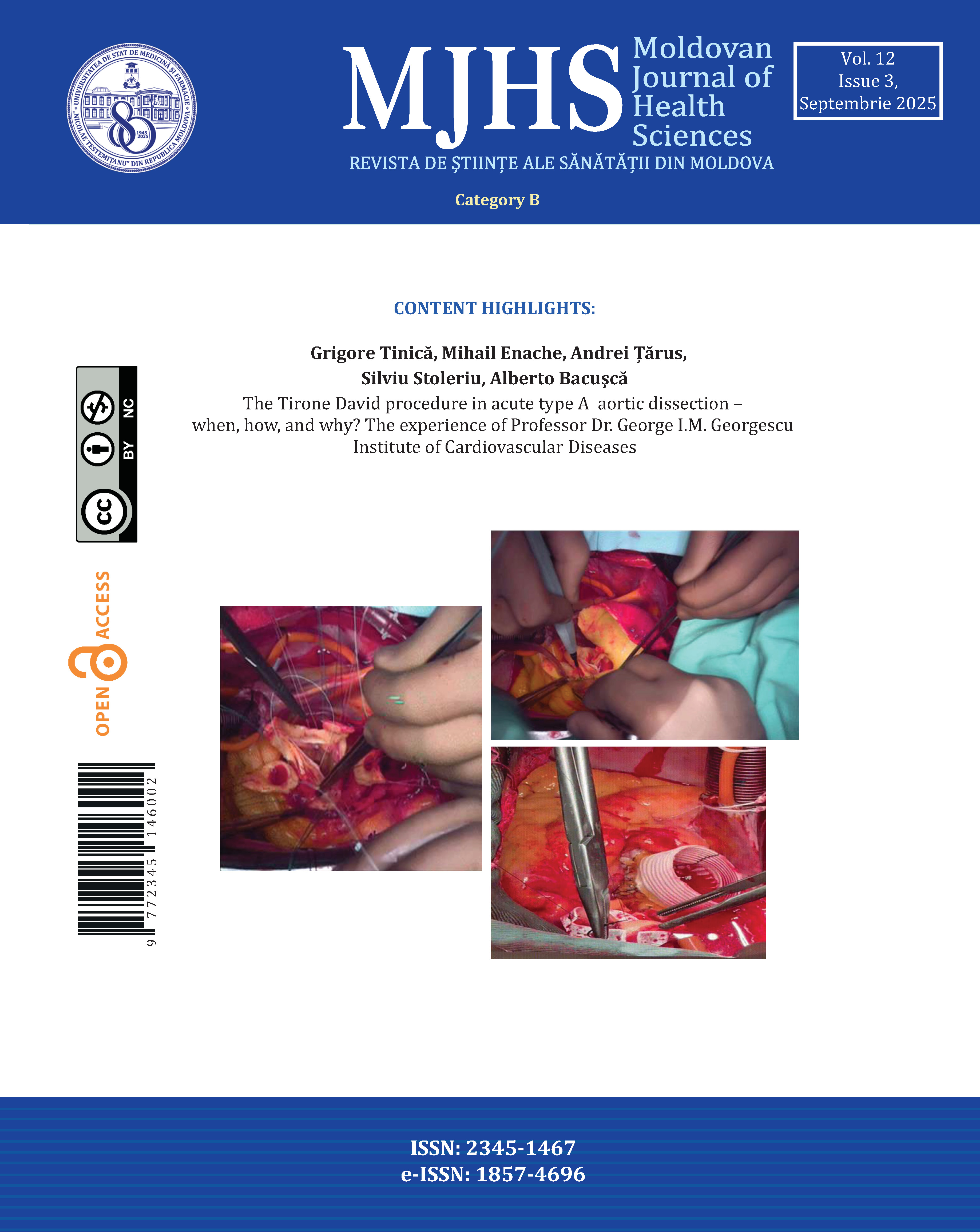
The Tirone David procedure in acute type A aortic dissection – when, how, and why? The experience of Professor Dr. George I.M. Georgescu Institute of Cardiovascular Diseases

Grigore Tinică1,2,3, Mihail Enache1,2, Andrei Țărus1,2, Silviu Stoleriu1,2, Alberto Bacușcă1,2
https://doi.org/10.52645/MJHS.2025.3.01

Introduction

Acute type A aortic dissection represents a life-threatening cardiovascular emergency with catastrophic natural history and extremely high mortality in the absence of prompt surgical intervention. Over the last decades, surgical management has evolved from supracoronary replacement and composite root replacement (Bentall procedure) towards valve-sparing strategies, among which the Tirone David reimplantation procedure has gained increasing acceptance.

Material and methods 

We performed a single-center, retrospective observational study at the Professor Dr. George I.M. Georgescu Institute of Cardiovascular Diseases, Iasi, Romania, reviewing all patients undergoing surgery for acute type A aortic dissection over a 25-year period (January 2000 – January 2025). According to intraoperative anatomy and hemodynamic status, patients were treated with one of the following strategies: supracoronary ascending aortic replacement (with or without valve replacement), composite root replacement (Bentall), or valve-sparing aortic root replacement (Tirone David).

Results 

A total of 256 patients were operated for acute type A aortic dissection. Mean age was 55.8 years, with male predominance (69%). Hypertension was the most frequent risk factor (75%), and severe aortic regurgitation was present in 48% of cases. Valve-sparing root replacement was performed in 73% of patients (84% in the last 4 years), of which 16% were Tirone David procedures. Operative mortality was 13.7%, with a favorable downward trend over time. The most common complications were acute renal failure (21.5%, with hemodialysis in 16.8%), atrial fibrillation (18%), infectious complications (14-17%), neurological events (9.9%), and re-exploration for bleeding (11.3%). Median ICU stay was 9.8 days, and median hospital stay 17 days.

Conclusions

In carefully selected patients with repairable cusps and reconstructable aortic root, the Tirone David procedure is our operation of choice, providing preservation of physiological hemodynamics and avoidance of lifelong anticoagulation. The Bentall operation remains indicated for irreparable valves, severely fragile tissue, or critical hemodynamic instability, where procedural simplicity and predictability are paramount. Our institutional experience demonstrates that the Tirone David procedure is feasible and safe in the acute setting, with encouraging early outcomes and a trend toward improved survival.
Vizualizează articol

Development of the facial nerve and its specific features

Angela Babuci1*, Zinovia Zorina1, Ilia Catereniuc1, Nataliya Trushel2, Anastasia Bendelic1, Nadia Ostahi1, Sofia Lehtman3
https://doi.org/10.52645/MJHS.2025.3.02

Introduction

The data reported in the specialty literature on the embryogenesis of the facial nerve mainly refer to the initial stages of its development. Nevertheless, the intrauterine development of the facial nerve is a complex and insightful process, characterized by a range of peculiarities. The goal of our study was to highlight the specific developmental features of the facial nerve for a better understanding of its morphology in adults.

Material and methods

Fifty-two groups of serially sectioned human embryos and fetuses from the embryo-fetal collection of the Department of Normal Anatomy at the Belarusian State Medical University in Minsk were investigated. The embryonic samples were classified according to Carnegie stages (day of gestation and crown-rump length). For protocols description, an OLYMPUS CX31 binocular microscope (eyepiece 10x, objectives 4x; 10x; 40x; 100x) and a Nikon DS-Fi1 camera were used.

Results

The primary and secondary divisions of the facial nerve trunk, the chorda tympani, the greater petrosal nerve, and the intracerebral and peripheral connections of the facial nerve were distinguished at Carnegie stage 15. The first appearance of intraplexal connections within the parotid plexus was identified at Carnegie stage 16. At stage 20, thin connections between the geniculate ganglion and the vestibular ganglion were revealed. Macro- and microstructural changes in the geniculate ganglion were noted throughout its development. The plexiform nature of the peripheral divisions of the facial nerve and the formation of the pes anserinus minor were observed at stage 21. At Carnegie stage 23, the motor nucleus was well developed, and the internal knee of the facial nerve was identified.

Conclusions

Early specific features of facial nerve development include: 1) intracerebral and peripheral connections with neighboring cranial nerves; 2) intraplexal connections between branches of the parotid plexus; 3) distinguishable intracerebral pathways; 4) connections between the geniculate and vestibular ganglia. Late developmental peculiarities include: 1) progressive macro- and microstructural changes in the geniculate ganglion; 2) appearance of the pes anserinus minor; 3) formation of the motor nucleus, internal knee, and intracerebral pathways. These specific developmental features of the facial nerve provide clear evidence of its complex morphology in adults.

Vizualizează articol

Variants of the common carotid artery branching patterns

Nadia Ostahi*, Angela Babuci, Ilia Catereniuc, Anastasia Bendelic, Zinovia Zorina
https://doi.org/10.52645/MJHS.2025.3.03

Introduction

The common carotid artery is the main source of blood supply to the head and neck regions. Its branching patterns are of great interest in terms of both anatomical and clinical significance. Variability of the common carotid artery can influence the planning of vascular, endovascular and oncological interventions in the head and neck regions, to avoid vessel injuries as well as intra-operative and postoperative complications.

Material and methods

Variants of branching patterns of the common carotid artery were studied retrospectively on a sample size of 210 patients (118 males and 92 females). The mean age of patients was 63.6±13.44 years for males and 65.1±14.32 years for females (p = 0.444). Patients were examined by CT angiography, during the period 2020-2024, within the Institute of Emergency Medicine and Republican Center for Medical Diagnostics. The purpose of this article was to identify anatomical variations in the branching pattern of the CCA based on gender and laterality.

Results

The most frequent variant of the CCA branching pattern, considered a normal variant, was its bifurcation, identified on the right side in 70% of cases (n = 147) and on the left side in 54% (n = 113). The trifurcation of the CCA was more common on the left side (33.3%), compared to the right side (25.7%). The origin of the superior thyroid artery from the CCA trunk was observed in 12.8% of cases on the right side and in 3.8% on the left one. A rare variant revealed in the current study was the origin of the lingual artery from the CCA trunk (0.4%).

Conclusions

The branching variants of the common carotid artery are of clinical significance, particularly in surgical interventions on the neck. Knowledge of the topographic relationships of the CCA with the neighboring anatomical landmarks is essential to prevent intra-operative complications and improve the quality of surgical management.

Vizualizează articol

Diastolic dysfunction and myocardial ischemia in TAVI patients

Marcel Abraș1,2*, Ecaterina Pasat2, Maria-Magdalena Vicol2, Cătălina Ciorici1, Daniela Bursacovschi2
https://doi.org/10.52645/MJHS.2025.3.04

Introduction

Severe aortic stenosis and ischemic coronary artery disease are frequently associated in elderly patients, adding complexity to interventional management. Diastolic dysfunction, a marker of myocardial impairment and elevated filling pressures, may influence prognosis after transcatheter aortic valve implantation (TAVI), particularly in the presence of concomitant coronary pathology. The aim of the study was to analyze the interaction between severe aortic valve stenosis, left ventricular diastolic dysfunction, and coronary ischemia in elderly patients with complex cardiovascular disease.

Material and methods

This was a prospective analytical cohort study including 85 patients treated between 2019 and 2023, divided into two groups: Group I – TAVI without coronary intervention (n = 56), and Group II – TAVI associated with percutaneous coronary intervention (PCI) (n = 29), consisting of patients with significant coronary lesions. Echocardiography was performed according to the ESC/EACVI 2016 guideline standards, with detailed assessment of diastolic function.

Results

The prevalence of left ventricular diastolic dysfunction of varying severity showed a statistically significant difference between groups (p = 0.04): Group I – 35 patients (62.5%) versus Group II – 24 patients (82.7%). The E-wave velocity was lower in Group II: 152.4 cm/sec (IQR = 43.0) compared to 173.0 cm/sec (IQR = 32.0), p = 0.01. The E/A ratio and the incidence of E/A ≥2 showed a borderline significant difference (p = 0.04). Median E/e′ was higher in Group II – 9.2 (IQR = 5.4) compared to 6.4 (IQR = 4.2), p = 0.003. E/Vp was 1.2 (IQR = 0.4) versus 0.8 (IQR = 0.5), p < 0.001. Diastolic dysfunction was more frequent in Group II, with significantly different echocardiographic parameters, including decreased E-wave velocity, increased E/e′ and E/Vp ratios, and a higher incidence of E/A ≥2.

Conclusions

Patients undergoing both PCI and TAVI more frequently exhibited left ventricular diastolic dysfunction. The echocardiographic parameters E, E/e′, and E/Vp showed statistically significant differences, suggesting an additive impact of coronary artery disease on diastolic function impairment in the setting of severe aortic stenosis.

Vizualizează articol

Hiatal surface area measurement – a useful tool during laparoscopic antireflux surgery

Serghei Cumpătă1*, Vasile Guzun2, Vladimir Iacub1, Evghenii Guțu1
https://doi.org/10.52645/MJHS.2025.3.05

Introduction

Accurate measurement of the esophageal hiatus is essential during laparoscopic repair of hiatal hernia, especially in patients with gastroesophageal reflux disease. Traditional intraoperative assessments are often subjective and inconsistent. This study proposes a novel, objective method for measuring the hiatal surface area using digital photography and open-source image analysis software. 

Material and methods

Our study included 25 consecutive patients with hiatal hernia and gastroesophageal reflux disease undergoing laparoscopic fundoplication. During surgery, standardized digital photographs of the hiatal defect were captured with a fixed-size benchmark (1.0×1.0 cm). Images were analyzed postoperatively using ImageJ software to determine the hiatal surface area. Preoperative and 12-month postoperative symptom severity was measured using the Gastroesophageal Reflux Disease-Health Related Quality of Life score. Correlations between hiatal surface area, symptoms, and hernia recurrence were evaluated statistically. 

Results

The mean hiatal surface area was 5.4 ± 1.8 cm². A strong positive correlation was observed between hiatal surface area and preoperative symptoms severity (r = 0.69), as well as postoperative improvement (r = 0.74). At 12 months, 88% of patients achieved significant symptoms reduction (≥50% reduction in Gastroesophageal Reflux Disease-Health Related Quality of Life score). Recurrence of symptoms was noted in 12% of patients, all of whom had a hiatal surface area greater than 6.0 cm². Therefore, patients with a hiatal surface area ≥6.0 cm² showed a higher risk of recurrence and less symptoms improvement compared to those with smaller defects. 

Conclusions

The proposed intraoperative measurement technique is a simple, cost-effective, and reproducible tool for quantifying hiatal defects. It provides clinically meaningful information that can assist in surgical planning, predict postoperative outcomes, and identify patients who may benefit from reinforced crural repair.

Vizualizează articol

Age related detrusor overactivity and symptoms perception in women: role of Botulinum toxin A injection for refractory overactive bladder

Mihaela Ivanov*, Emil Ceban
https://doi.org/10.52645/MJHS.2025.3.06

Introduction

Detrusor overactivity has been detected in approximately 50% of women with overactive bladder symptoms. According to the NICE guidelines, urodynamic testing is mandatory confirm the diagnosis of detrusor overactivity before performing minimally invasive treatment. 

Material and methods

This study retrospectively analyzes 76 women, categorized into two groups based on age: reproductive age (n = 49) and climacteric period (n = 27), referred to the Timofei Moșneaga Republican Clinical Hospital between 2022 and 2024 for symptoms of overactive bladder. The research focused on physical examination, questionnaires, bladder diary, urinalysis, and urodynamic measurements before and after botulinum toxin type A injections in 30 patients with overactive bladder refractory to first-line therapy. 

Results

In women with overactive bladder, the reproductive group was as follows: moderate problems (51%) > very severe problems (31%), severe problems (18%) (p = 0.02); in the group of women in the climacteric period: severe problems (48%) > very severe problems (37%) > moderate problems (15%) (p = 0.10). Based on urodynamics data, the diagnosis of overactive bladder with detrusor overactivity was confirmed by establishing the presence of phasic contractions of the detrusor (3.9 ± 1.15), increased values of detrusor pressure (45.9 ± 23.9 cmH2O) and reduced bladder compliance (10.4 ± 11.4 ml/cmH2O). In 100% of cases, these findings predicted an effective botulinum toxin type A injection. Daytime urinary frequency, nocturia, and urinary urgency scores improved significantly after botulinum toxin type A injection by 41.7%, 26.1% and 34.1%, respectively. 

Conclusion

The study revealed age differences in overactive bladder symptom severity between the women in both groups. The reproductive period group experienced moderate complications, while the climacteric period group had more severe complications. Administration of botulinum toxin type A through detrusor injection has been shown to be efficacious in the management of overactive bladder.

Vizualizează articol

Targeting the biochemical signature of age-related macular degeneration: a preliminary study of potential diagnostic and prognostic biomarkers

Ecaterina Pavlovschi*, Angela Untila, Svetlana Protopop, Ala Ambros, Olga Tagadiuc
https://doi.org/10.52645/MJHS.2025.3.07

Introduction

Age-related macular degeneration is a multifactorial, polyetiological condition, affecting individuals over the age of 50, primarily characterized by progressive and irreversible loss of central vision. In the pursuit of a deeper understanding of its etiopathogenesis, risk factors, associated biomarkers, and diagnostic metabolites, the omics approach plays an essential role. The primary objective of this study was to evaluate selected omics biomarkers along with hematological and clinical data and to establish their correlations with macular degeneration,

Material and methods

A pilot retrospective study was conducted, analyzing medical records of 80 patients admitted to the Ophthalmology Department of the Timofei Moșneaga Republican Clinical Hospital. Laboratory parameters were assessed and statistically analyzed using the Statistical Package for the Social Sciences. Statistical methods included binomial tests, Wilcoxon Signed-Rank tests, and One-sample tests. The data obtained were compared with the results of a comprehensive analysis of the latest scientific literature on age-related macular degeneration.

Results

Omics approach analysis, particularly proteomic and metabolomic analyses, has contributed significantly to the identification of metabolic pathways involved in age-related macular degeneration pathogenesis, facilitating the investigation of novel biomarkers for early diagnosis and potential therapeutic targets. In our pilot study, we evaluated clinical and biochemical data, including age, sex, laboratory values, and comorbidities, and compared them with currently published research data. Statistically significant biomarkers identified included glucose, triglycerides, prothrombin, fibrinogen, platelet count, and leukocyte count. Partially significant (dual) biomarkers included total cholesterol, erythrocyte sedimentation rate, and lymphocyte count. No statistical significance was observed for HDL-cholesterol, LDL-cholesterol, and international normalized ratio.

Conclusions

Omics approach represents a promising avenue for monitoring, diagnosing, and potentially treating age-related macular degeneration. By identifying key biomarkers, this approach supports early detection and opens the path for advanced therapeutic strategies such as gene therapy, cell-based treatments, complement pathway inhibitors, and nanotechnology-based interventions.

Vizualizează articol

Community-acquired pneumonia in chronic heart failure: approach through the oxidative stress and systemic inflammation

Virginia Cascaval1*, Tatiana Dumitras1, Diana Fetco-Mereuta1, Sergiu Matcovschi1, Livi Grib2
https://doi.org/10.52645/MJHS.2025.3.08

Introduction

Diagnosing community-acquired pneumonia in patients with chronic heart failure can be challenging. Oxidative stress and inflammatory response play an important role in the development and diagnosis of community-acquired pneumonia and are also involved in many cardiovascular diseases, including chronic heart failure. 

Materials and methods

A total of 210 patients were enrolled and divided into two groups: group 1 (n = 105) – patients with community-acquired pneumonia associated with chronic heart failure, and group 2 (n = 105) – patients with community-acquired pneumonia without chronic heart failure. Several biomarkers were measured. For oxidative stress, we assessed prooxidant markers (ischemic modified albumin, advanced glycation end-products, advanced oxidation protein products, malonic dialdehyde) and antioxidant markers (total antioxidant activity with CUPRAC and ABTS methods, superoxide dismutase and catalase). Inflammatory status was assessed by determining leukocyte count, erythrocyte sedimentation rate, lactate dehydrogenase, fibrinogen and C-reactive protein. In all patients, N-terminal pro b-type natriuretic peptide values were determined.

Results

The age of patients in the study group ranged from 50 to 92 years, with an overall mean of 70.6 ± 8.89 years (95% CI [68.8-72.3]), (F = 18.109; p = 0.205). Ischemic modified albumin values were higher in patients in Group 1 compared to Group 2: 236.60 ± 57.23 µM/L and 229.77 ± 64.35 µM/L, respectively (F = 0.660; p = 0.045). Serum lactate dehydrogenase had higher values in Group 1, compared to the control group: 232.65 ± 109.80 units/L and 192.40 ± 44.98 units/L, respectively (p = 0.001). The mean fibrinogen values ​​were also higher in Group 1 (5.24 ± 1.60 g/L), compared to Group 2 (4.51 ± 1.78 g/L), p = 0.002. Total antioxidant activity by CUPRAC method, had higher values ​​in Group 1 (6.70 ± 4.62) versus Group 2 (4.99 ± 2.29), p = 0.006.

Conclusions

The coexistence of community-acquired pneumonia and chronic heart failure resulted in a higher inflammatory response and greater accumulation of pro-oxidative reaction products. This condition was characterized by increased serum lactate dehydrogenase, erythrocyte sedimentation rate and fibrinogen levels. Furthermore, the state of heightened oxidative stress was marked by increased ischemic modified albumin and total antioxidant activity detected with CUPRAC method.

Vizualizează articol

The impact of comorbidities on chronic obstructive pulmonary disease

Ecaterina Iavrumov*, Alexandru Corlateanu
https://doi.org/10.52645/MJHS.2025.3.09

Introduction

Chronic obstructive pulmonary disease is a major cause of morbidity and mortality worldwide, often associated with multiple comorbidities that may complicate its clinical course. These comorbidities can exacerbate respiratory symptoms, impair lung function, alter imaging findings, and significantly affect prognosis.

Material and methods

This analytical, observational, cross-sectional study included 80 patients with confirmed chronic obstructive pulmonary disease, divided into two equal subgroups according to spirometric severity: GOLD 1-2 (n = 40) and GOLD 3-4 (n = 40). Clinical, functional, and radiological parameters were evaluated. Comorbidity burden was assessed using validated composite indices: Charlson Comorbidity Index, COTE, COPDCoRi, CODEX, and COMCOLD. Associations between comorbidity scores, pulmonary function, high-resolution computed tomography findings, and clinical outcomes were analyzed using SPSS v22.0. A p-value < 0.05 was considered statistically significant.

Results

The presence of comorbidities was high across all domains, with only minor differences between spirometric stages. Structural abnormalities (emphysema, bronchiectasis, pulmonary hypertension) were more prevalent in GOLD 3-4 patients. A strong correlation was observed between composite indices and parameters such as forced expiratory volume in 1 second,dyspnea, exacerbation rate, radiological findings, and GOLD stages. Logistic regression models showed that the combination of COPD-specific indices (COTE, CODEX, COPDCoRi) significantly outperformed the Charlson index in predicting severe COPD (AUC 0.86 vs. 0.63). High-resolution computed tomography findings variables also demonstrated strong predictive value (AUC 0.81).

Conclusions

Comorbidities play a central role in shaping chronic obstructive pulmonary disease severity and prognosis. The integration of composite comorbidity indices and imaging biomarkers enhances multidimensional patient stratification, aligning with GOLD 2024 recommendations for personalized care.

Vizualizează articol

Natural course of inflammatory cardiomyopathies

Andrei Braniște1, Vladimir Naumov2, Valeriu Cobeț1, Tudor Braniște3*
https://doi.org/10.52645/MJHS.2025.3.10

Introduction

Refractory heart failure with a poor prognosis is a key feature of dilated cardiomyopathy. Inflammatory cardiomyopathy, often diagnosed via in vivo subendomyocardial biopsy, is considered a potential precursor to dilated cardiomyopathy. The Dallas criteria, applied to morphometric and electron microscopic studies of biopsy samples, are essential for differentiating the features of various inflammatory stages. Building upon these established diagnostic principles, our study integrates immunohistological analysis with measurements of intramyocardial indices and intracardiac hemodynamics. This comprehensive approach aims to characterize the natural course of inflammatory cardiomyopathy, seeking to improve the understanding of the clinical trajectories and tissue structures that define both inflammatory cardiomyopathy and its progression to dilated cardiomyopathy.

Material and methods

The study included 75 patients with inflammatory cardiomyopathies and 75 patients with dilated cardiomyopathies. The following procedures were performed: coronary angioventriculography, repeated subendomyocardial biopsy, immunohistologic analysis, and assessment of intracardiac and intramyocardial hemodynamics. 

Results

Morphohistologic analysis of inflammatory cardiomyopathies at different stages revealed a maximum of 10-12 lymphocytes, which decreased to only isolated lymphocytes in late stages. In biopsies from early-stage inflammatory dilated cardiomyopathies, the morphologic appearance showed lymphocytic infiltration of the myocardial stroma, vasculitis of intramural arteries and arterioles. The biopsies performed after 36 months showed dystrophic structures, microfocal and diffuse replacement fibrosis, predominantly perivascular, which are indistinguishable from the features of dilated cardiomyopathy. Intracardiac hemodynamic indices in patients with dilated and inflammatory cardiomyopathies did not differ. Similarly, left ventricular regional contractility, as verified by radiopaque ventriculography, was not significantly different. The degree of radiotracer detection on thallium-201 scintigraphy was statistically insignificant between the two conditions. Immune complexes and immunoglobulins G, M, and A in the blood were elevated in both groups, likely as a consequence of heart failure. 

Conclusions

Morphostructural analysis of biopsies taken from patients with inflammatory dilated cardiomyopathies, at different stages of its natural course reveals the progressive development of dilated cardiomyopathies. These structural changes correlate closely with findings from intracavitary and hemodynamic assessments and measures of regional contractility, supporting a direct link between dilated and inflammatory cardiomyopathies.

Vizualizează articol

Lipid profile in young people

Diana Chiosa1*, Rodica Ignat1, Alexei Levițchi2, Ghenadie Curocichin1,2
https://doi.org/10.52645/MJHS.2025.3.11

Introduction

Metabolic risk factors for non-communicable chronic diseases develop from an early age, while the clinical manifestations of cardiovascular diseases associated with these risk factors appear later in life. Dyslipidemia is a modifiable risk factor for cardiovascular diseases. The purpose of the study was to evaluate the lipid profile in young people as an early risk factor for cardiovascular disease.

Material and methods

The study was conducted on 693 healthy young individuals: 71.4% (495) women and 28.6% (198) men, aged between 17 and 30 years. The measured parameters included total cholesterol, HDL-cholesterol, LDL-cholesterol, and triglycerides, measured using the spectrophotometric method. Non-HDL cholesterol was calculated with the formula: non-HDL-C = TC – HDL-C (mmol/l).

Results

A total of 8.2% of young people had total cholesterol levels above the normal threshold (5.0 mmol/l). HDL-cholesterol below the gender-specific threshold values was recorded in 52.5%. Among women, 58.8% had HDL-cholesterol levels ≤ 1.29 mmol/l, and among men, 36.9% had levels below 1.03 mmol/l. Non-HDL cholesterol exceeded the threshold value (3.8 mmol/l) in 5.9% of young people. For 21.4% of participants, LDL-cholesterol was above the threshold (2.59 mmol/l), and 8.2% had triglyceride levels above the normal threshold (1.7 mmol/l).

Conclusions

The study demonstrated that over half of the young people (52.5%) had HDL-cholesterol below the gender-specific thresholds. Deviations in the lipid profile increase the atherogenic potential of plasma, highlighting the need for early preventive interventions in this age group.

Vizualizează articol

Acute kidney injury – a severe complication secondary to COVID-19

Marinela Murea*, Andrei Bradu, Andrei Oprea, Andrei Galescu, Emil Ceban
https://doi.org/10.52645/MJHS.2025.3.12

Introduction

The COVID-19 pandemic has posed the biggest challenge to the global health system. Kidney damage is common in COVID-19 and ranges from mild proteinuria to severe acute kidney injury.

Objective. The aim of the study was to establish the dynamics of COVID-19 in patients who develop acute kidney injury and to identify risk factors for developing acute kidney injury associated with COVID-19.

Materials and methods

A retrospective descriptive study was conducted, including 40 patients of both sexes, aged between 37 and 88 years, who were admitted to the intensive care unit of the Timofei Moșneaga Republican Clinical Hospital during the period 2020-2022. Statistical analysis was performed using the Student’s t-test.

Results

The most common factors identified as determinants were advanced age, comorbidities, mechanical ventilation, and nephrotoxic drugs. The presence of proteinuria, hematuria, and leukocyturia was identified. Urea and creatinine levels were elevated on admission and continued to rise; 10% of patients required renal replacement therapy. It was observed that the greater the degree of lung damage, the earlier mechanical ventilation was instituted, which could lead to the development of early acute kidney injury. All patients were mechanically ventilated and developed acute kidney injury, contributing to a severe course of COVID-19.

Conclusions

Acute kidney injury is one of the most frequent and severe complications encountered among mechanically ventilated patients with severe forms COVID-19 and is often associated with a fulminant course and a high mortality rate.

Vizualizează articol

Sarcopenia and frailty: risk profiles in patients with chronic heart failure

Anastasia Ivanes1*, Lucia Mazur-Nicorici1, Virginia Șalaru2, Livi Grib1, Snejana Vetrilă1
https://doi.org/10.52645/MJHS.2025.3.13

Introduction

Patients with heart failure frequently present with varying degrees of skeletal muscle dysfunction, from early fatigue to sarcopenia and cachexia. Sarcopenia, defined as the loss of muscle mass and/or function, contributes to the physical dimension of frailty. Both conditions are associated with adverse outcomes in heart failure. Although sarcopenia and frailty often coexist, they are distinct syndromes with a bidirectional relationship with heart failure. According to European data, the prevalence of sarcopenia ranges from 20-50% in heart failure with reduced ejection fraction and approximately 18% in heart failure with preserved ejection fraction. This study aimed to evaluate sarcopenia among frail patients with chronic heart failure and to identify associated risk and protective factors.

Material and methods

A cross-sectional observational study was conducted on 44 frail patients with chronic heart failure. Data collection included clinical, functional, and anthropometric parameters, using the SARC-Calf questionnaire, gait speed and the Timed Up and Go test. Patients were stratified into three study groups according to frailty severity assessed by the Edmonton Frail Scale: Study Group 1 – mild frailty, Study Group 2 – moderate frailty, and Study Group 3 – severe frailty. Statistical analysis included Chi-square and Fisher’s exact tests. Odds Ratios with 95% Confidence Intervals were calculated. A p < 0.05 was considered statistically significant.

Results

Of the 44 patients included, 32 (72.7%) were women and 12 (27.3%) men, with a mean age of 67.3 ± 8.9 years. Sarcopenia risk (SARC-Calf ≥4) was identified in 56.8%, and severe sarcopenia in 15.9%, exclusively among women. Functional impairment was present in 88.9% of Study Group 1, 91.7% of Group 2, and 100% of Group 3. Arterial hypertension (71.4%), diabetes mellitus (57.1%), and obesity (42.8%) were more prevalent among sarcopenic patients. C-reactive protein levels >6 mg/L and elevated NT-proBNP were associated with sarcopenia risk (p = 0.039). Metformin use was linked to absence of sarcopenia (p = 0.008), while low physical activity, statin use, and inflammation were more frequent in sarcopenic patients.

Conclusions

Sarcopenia was highly prevalent in frail heart failure patients, particularly among women. Cardiac dysfunction, inflammation, and metabolic comorbidities are key contributors, highlighting the need for early screening and tailored interventions.

Vizualizează articol

Osteocalcin and metabolic dysfunction in young women with obesity

Carolina Piterschi1,2 ⃰, Lorina Vudu1,2
https://doi.org/10.52645/MJHS.2025.3.14

Introduction

Osteocalcin, a bone-derived hormone, has emerged as a potential regulator of energy metabolism, with roles in insulin sensitivity, glucose homeostasis, and lipid metabolism. Although an inverse association between osteocalcin and body mass index has been previously reported, data on its link with metabolic parameters in young, otherwise healthy women with obesity remain limited. The objective of this study was to investigate the relationship between circulating osteocalcin levels and key metabolic parameters in this specific population.

Material and methods

A cross-sectional observational study was conducted among 85 Caucasian women aged 18-45 years, without chronic disease or medication use. Participants were classified into two groups: normal weight (BMI 18.5-24.9 kg/m², n = 47) and with obesity (BMI ≥ 30 kg/m², n = 38). Anthropometric, hemodynamic, and biochemical parameters, including glucose, insulin, lipid profile, osteocalcin, and adiponectin, were assessed. Insulin resistance was evaluated using HOMA-IR and QUICKI. Group comparisons and Pearson correlation analyses were performed. 

Results

Osteocalcin levels were significantly lower in the group of women with obesity compared to the normal weight group (12.99 ± 4.7 vs. 19.75 ± 4.09 ng/mL, p < 0.001). It was inversely correlated with BMI (r = – 0.56), waist-to-hip ratio, waist-to-height ratio, insulin, HOMA-IR, total and LDL cholesterol, and positively associated with QUICKI (r = 0.39) and adiponectin (r = 0.31) (all p < 0.001). A progressive decline in osteocalcin levels was observed across obesity grades.

Conclusions

Circulating osteocalcin is inversely associated with adiposity and metabolic dysfunction, suggesting its potential as an early biomarker of cardiometabolic risk in young women with obesity.

Vizualizează articol

Evaluation of cardiovascular risk factors in juvenile idiopathic arthritis

Livia Bogonovschi*, Angela Cracea, Ninel Revenco
https://doi.org/10.52645/MJHS.2025.3.15

Introduction

Juvenile idiopathic arthritis is a persistent type of arthritis with no defined cause that develops before the age of 16 years and lasts for at least 6 weeks. The aim of the study was to evaluate cardiovascular risk factors (homocysteine, total cholesterol, and triglycerides) in juvenile idiopathic arthritis.

Material and methods

The study was carried out in the Rheumatology Department of the Mother and Child Institute,Chisinau, Republic of Moldova. The patients’ parents signed the written consent to participate in the study. The study was approved by the Ethics Committee of the Nicolae Testemițanu State University of Medicine and Pharmacy. The study included 90 children with JIA. The number of painful and swollen joints, the global evaluation of the disease by both the physician and patient, as well as the Childhood Health Assessment Questionnaire, were determined. Paraclinical tests included a complete blood count, acute-phase markers of inflammation (erythrocyte sedimentation rate, C-reactive protein) and the cardiovascular risk factors of interest (homocysteine, total cholesterol, and triglycerides).

Results

Patients with JIA exhibit a relatively higher risk of hyperhomocysteinemia compared to controls. Additionally, individuals with JIA display a relatively moderate risk of hypercholesterolemia and a relatively lower risk of hypertriglyceridemia. Thus, a correlation was noted between JIA and hypercholesterolemia, with a slight inclination towards increased triglyceride levels in these children.

Conclusions

Patients with juvenile idiopathic arthritis are at risk for hyperhomocysteinemia, hypercholesterolemia, and hypertriglyceridemia.

Vizualizează articol

Targeting redox balance: antioxidant effects of thiosemicarbazones on human peripheral blood

Valeriana Pantea1, Ecaterina Pavlovschi1,2*, Silvia Stratulat2, Aurelian Gulea3, Olga Tagadiuc2, Valentin Gudumac1
https://doi.org/10.52645/MJHS.2025.3.16

Introduction

Thiosemicarbazones represent a class of organic compounds with well-documented pharmacological properties, including antitumor, antimicrobial, and antiviral activities. Contemporary research highlights their role in modulating cellular redox equilibrium through antioxidant pathway regulation. The growing interest in copper-based coordination complexes with thiosemicarbazones is driven by the unique redox flexibility and high biocompatibility of copper ions, properties that underlie their potential in therapeutic and diagnostic applications. This investigation assessed the capacity of specific local bioactive thiosemicarbazones to impact the antioxidant system using in vitro methodologies. 

Material and methods

Peripheral blood samples from ten healthy volunteers were used to evaluate in vitro the influence of 10 copper-based coordination complexes with thiosemicarbazones at concentrations of 10.0 μM/L and 1.0 μM/L on antioxidant markers ‒ total antioxidant activity (via ABTS assay), total antioxidant capacity, antioxidant substance mass, and antioxidants total activity. 

Results

Data indicated that targeted copper-based coordination complexes with thiosemicarbazones affect general antioxidant markers. The study demonstrates that thiosemicarbazones exhibit concentration- and structure-dependent redox modulation, disclosing distinct mechanisms of action across three structural classes – benzothiazole, phenyl, and allyl thiosemicarbazone derivatives. Structural optimization (e.g., benzothiazole with methoxy groups) yields compounds like MG-22 that maintain redox equilibrium, while pro-oxidant variants (CMA-18) offer therapeutic potential through selective oxidative cytotoxicity.

Conclusions

Copper-based coordination complexes with thiosemicarbazones represent a promising class of redox modulators with tunable biological effects. Their bidirectional activity, manifested by stimulation or inhibition of antioxidant mechanisms, confirms the potential of these derivatives as selective therapeutic agents. When these results are integrated in the context of personalized medicine, thiosemicarbazones become valuable candidates in the development of therapeutic strategies aimed at maintaining cellular homeostasis, especially in pathologies characterized by increased oxidative stress, such as cancer and neurodegenerative diseases.

Vizualizează articol

The effectiveness of using a checklist in prehospital stroke interventions in the Republic of Moldova

Natalia Catanoi1,2, Mihail Peștereanu1*, Larisa Rezneac1,2, Natalia Mocanu1
https://doi.org/10.52645/MJHS.2025.3.17

Introduction

Stroke remains a major cause of mortality and disability in Moldova and globally. Rapid prehospital intervention is critical for improving outcomes. The adoption of standardized protocols and checklists has enhanced the efficiency of emergency medical services (EMS), especially in stroke recognition and initial management.

Materials and methods

A systematic review of the literature and analysis of statistical data from the National Prehospital Emergency Medical Service were conducted. The study focused on evaluating the use and impact of checklists during prehospital stroke interventions.

Results

Between 2022 and 2023, over 12,000 stroke cases were recorded annually. The implementation of national checklists, in conjunction with the Face, Arm, Speech, Time scale, significantly improved early identification, triage, and transport to specialized centers. Notable outcomes included a higher rate of thrombolysis and thrombectomy, improved coordination, and a modest reduction in overall response time. However, delays due to inter-hospital transfers remain a challenge.

Conclusions

The systematic use of checklists in prehospital stroke management in Moldova proved effective in standardizing care, accelerating intervention, and improving patient outcomes. Continued training and system reorganization are crucial to fully capitalize on these tools and to reduce stroke-related morbidity and mortality.

Vizualizează articol

Identifying core stigmatizing beliefs about depression: results from an item-level statistical approach

Jana Chihai1, Andrei Esanu1*, Igor Nastas1,2, Inga Deliv1, Alina Bologan1, Cornelia Adeola1, Radislav Coșulean2, Madalina Bivol2, Mihaela Belous2, Dorin Jelaga1, Romil Popescu1
https://doi.org/10.52645/MJHS.2025.3.18

Introduction

Stigma surrounding depression continues to be a major barrier to treatment, social inclusion, and recovery. While general attitudes toward mental illness have been widely studied, fewer investigations have focused on the specific beliefs that drive stigma toward individuals with depression in a low- and middle-income country (LMIC) in Eastern European settings, particularly in Moldova.

Material and methods

A cross-sectional study was conducted with a sample of 460 participants from Moldova, who completed the Depression Stigma Scale. Each of the nine items reflected a different stigmatizing belief about depression. Descriptive statistics, including mean scores and standard deviations, were calculated for each item. An item-level comparative analysis was performed.

Results

The highest stigma scores were recorded for items such as: “I would not employ someone if I knew they had been depressed”, “Depression is not a real medical illness”, and “Depression is a sign of personal weakness.” The lowest scores were observed for beliefs related to dangerousness and avoidance, including “People with depression are dangerous” and “It is best to avoid people with depression so you don’t become depressed yourself.” These results suggest that stigma in Moldova is predominantly characterized by doubts about the medical legitimacy of depression and concerns over professional roles, rather than fear-based or exclusionary attitudes.

Conclusion

Anti-stigma interventions in LMICs, such as Moldova should prioritize improving public understanding of depression as a legitimate health condition and addressing discrimination in professional settings.

Vizualizează articol

Tuberculosis in new cases: the impact of HIV status on clinical manifestations

Igor Ivanes*, Aurelia Ustian, Constantin Iavorschi, Alexandru Corlăteanu
https://doi.org/10.52645/MJHS.2025.3.19

Introduction

Tuberculosis continues to be the primary cause of death among individuals living with human immunodeficiency virus, with co-infection significantly influencing the clinical course, severity, and outcomes of the disease. Although the interaction between the two conditions is well recognized, regional data from Eastern Europe remain insufficient.

Material and methods

A retrospective, cross-sectional comparative study was carried out in the Republic of Moldova in 2021. A total of 320 patients with newly diagnosed pulmonary tuberculosis were included and divided into two matched groups: the study group consisted of 160 patients with confirmed human immunodeficiency virus co-infection, and the control group included 160 patients without human immunodeficiency virus infection. The groups were comparable in terms of age, sex, residence, and resistance profile of Mycobacterium tuberculosis. Data were collected from national clinical records and analyzed using descriptive statistical methods.

Results

Among 320 patients, those with HIV co-infection had significantly higher rates of generalized TB (28.8% vs. 2.5%; p < 0.0001), subacute onset (71.9% vs. 22.5%; p < 0.0001), and severe/very severe condition at diagnosis (27.4% vs. 10.6%; p = 0.0017). Anemia (58.8% vs. 23.1%; OR = 4.73, p < 0.0001), leukopenia (16.3% vs. 1.3%; OR = 15.33, p < 0.0001), and ESR >60 mm/h (25.0% vs. 5.6%; OR = 5.59, p < 0.0001) were significantly more common in co-infected patients. Bilateral lung lesions were more frequent (65.6% vs. 59.4%), while cavitary destruction predominated in TB-only patients (59.4% vs. 34.4%; p < 0.0001). Smear positivity was lower in the HIV group (38.8% vs. 55.0%; p = 0.0036). Complications (48.1% vs. 20.6%; p < 0.0001) and opportunistic infections (17.5% vs. 0%) were more prevalent in co-infected patients. Mortality was significantly higher among HIV-positive cases (28.1% vs. 6.9%; OR = 5.20, p < 0.0001).

Conclusions

Human immunodeficiency virus infection significantly modifies the clinical presentation of tuberculosis, favoring more severe, atypical, and extrapulmonary forms, along with higher complication rates and mortality. These findings highlight the urgent need for early diagnosis, adapted diagnostic approaches, and integrated treatment strategies in patients with dual infection, particularly in high-burden settings.

Vizualizează articol

Comparative assessment of active compounds in Solidago species from the flora of the Republic of Moldova

Cornelia Fursenco1,2*, Violeta Alexandra Ion3, Tatiana Calalb1,2, Livia Uncu2,
https://doi.org/10.52645/MJHS.2025.3.20

Introduction

Solidago virgaurea (European goldenrod) and Solidago canadensis (Canadian goldenrod) are two plant species that have been extensively investigated for their complex phytochemical profiles, particularly represented by flavonoids, phenolic acids, saponins, and essential oils with notable antioxidant and anti-inflammatory properties.

Material and methods

Goldenrod plants were collected during the flowering period (2019–2024), S. virgaurea obtained from spontaneous flora and S. canadensis from the Scientific-Practical Center in the Domain of Medicinal Plants of Nicolae Testemitanu State University of Medicine and Pharmacy. The macroscopic analysis was performed using specific morphological indices of the Herba vegetal product, while the microscopic examination was performed on superficial preparations and cross-sections of vegetal material using a Micros microscope equipped with a digital imaging system. Dry extracts were prepared using repeated maceration, followed by phytochemical investigations employing qualitative color and sedimentation tests, ultraviolet-visible spectrophotometry (for total polyphenolic compounds, flavonoids, hydroxycinnamic acids, carotenoids, and saponins), and gas chromatography-mass spectrometry for essential oils. The antioxidant potential was assessed in vitro using the 2,2'-azino-bis(3-ethylbenzothiazoline-6-sulfonic acid) radical scavenging assay and the metal chelation method. In vivo pharmacological studies included antimicrobial activity, assessed via serial dilution in liquid nutrient media, and anti-inflammatory activity, evaluated using the xylene-induced ear edema model in mice and the carrageenan-induced paw edema model in rats.

Results

The biological, macroscopic, and microscopic investigations established reliable diagnostic criteria for the clear differentiation and identification of Herba-type vegetal products derived from the two Solidago species from the Moldovan flora. Qualitative phytochemical screening using specific color and sedimentation reactions confirmed the presence of flavonoids and triterpenic saponins in the examined vegetal products. Quantitative ultraviolet-visible spectrophotometric analysis revealed that S. canadensis contained relatively higher levels of bioactive compounds–flavonoids, hydroxycinnamic acids, saponins, and carotenoids–and exhibited greater antioxidant activity compared to S. virgaurea. Gas chromatography-mass spectrometry analysis showed that the essential oils of both species differ more quantitatively than qualitatively. Both Solidago species exhibited moderate anti-inflammatory and antibacterial activities.

Conclusions

The results of this complex study support the selection of the vegetal product Solidaginis canadensis herba as a promising candidate for the local pharmaceutical industry, serving as a valuable source of new local plant-derived antioxidant, anti-inflammatory, and antibacterial drugs.

Vizualizează articol